
GFunded prop firm reviews covering rules, fees, payouts
GFunded Prop Firm Reviews Rules, Costs, Platforms, Payout Notes Prop firm reviews can feel all over the place. One trader posts a smooth payout,…
GFunded Prop Firm Reviews Rules, Costs, Platforms, Payout Notes
Prop firm reviews can feel all over the place. One trader posts a smooth payout, another says they got flagged during a withdrawal review, and someone else loses an account on a rule they didn’t catch. That’s why GFunded prop firm reviews only help when you match them to the actual rules and trading conditions.
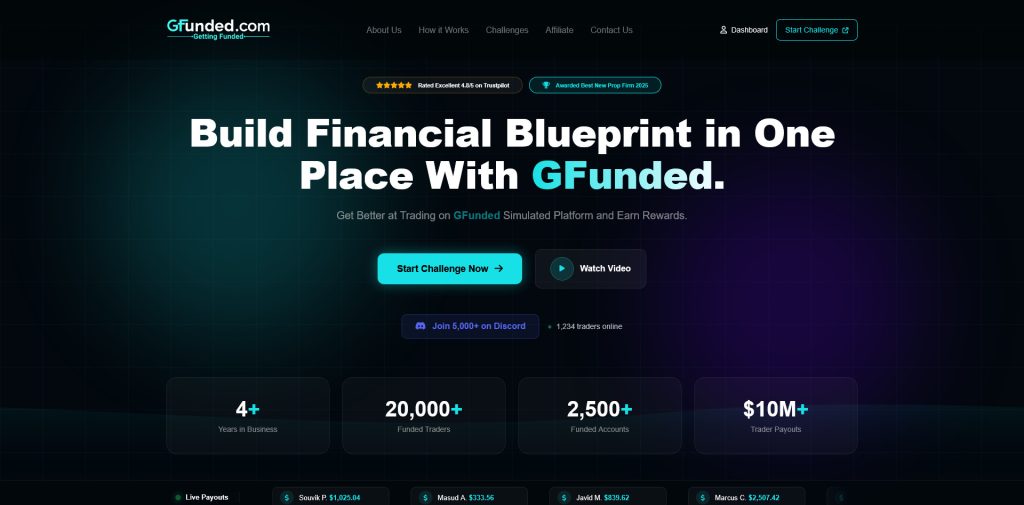
GFunded is usually described as a retail prop firm (operating since 2021) where you pay a one-time fee to trade under strict limits, often on a simulated account that can still pay real money. Like most prop firms, it’s typically unregulated, so trust comes less from labels and more from how clear the rules are, how strictly they’re enforced, and how payouts hold up when you request them.
In this guide, you’ll see the rule set that triggers most failures, including daily loss limits, max loss, and the big one many traders miss, trailing vs static drawdown (and whether it’s based on balance or equity). We’ll also break down what GFunded can really cost after add-ons, which platforms you might get (TradeLocker, DXTrade, Match Trader, plus occasional older platform listings in past reviews), and what to expect from payouts, KYC, and timing.
Details can change by plan and region. Eligibility can also be restricted, with the US and Canada often listed as blocked in 2026, so it’s smart to confirm access inside the dashboard and current terms before paying.
What GFunded is in 2026, and what you are really paying for
In 2026, GFunded is still best understood as a retail prop firm (commonly described as operating since 2021) that sells access to a rule-based trading program. You’re not depositing money into your own broker account. You’re paying a one-time fee to trade under a defined set of limits on a platform the firm provides, then you qualify for payouts if you follow the rules and hit the goals.
That business model explains why reviews feel split. Some traders report fast payouts (sometimes within a couple business days), while others complain about strict enforcement or extra checks during withdrawals. Both can be true at the same time, because the “product” is the rule set and the firm’s enforcement of it.
Evaluation plans vs Instant Funding, how to pick the route that fits your personality
Think of evaluation plans like a driving test. You prove you can control risk first, then you earn access to the payout stage. Most evaluation setups come with a profit target (often discussed around 10% on many plans) plus loss limits that can end your account fast if you oversize.
Instant Funding flips that. You can trade right away with no profit target, but many traders say it can feel tighter in practice because drawdown rules (often trailing-style on instant models) can punish normal pullbacks after you get into profit. You pay more upfront for speed, and you “pay” again by needing cleaner execution.
Here’s a simple way to choose based on how you trade:
- Patient rule follower: Pick an evaluation. You’ll handle the target and the minimum trading days better, and you’re less likely to rush into bad trades just to “get paid.”
- Impatient but disciplined trader: Instant Funding can fit if you already trade small, accept slow growth, and treat drawdown like a hard wall. You get to work right away, but you can’t wing it.
- New trader who still oversizes: Avoid both until position sizing is boring. Tight daily loss caps (many traders cite numbers like 4% to 5% depending on plan) can wipe you out in one emotional session.
Simulated account, real payouts, why this confuses people in reviews
Most traders don’t realize what they’re trading at first. With firms like GFunded, you’re often trading a simulated (demo-style) account, yet you can still receive real payouts. The payout isn’t coming from “your” deposited capital. It’s tied to performance and rule compliance under the firm’s program.
That’s why regulation is not the main trust signal here. What matters more is:
- Rule clarity: Are drawdown rules, news rules, and payout terms written in plain language?
- Enforcement: Are the rules applied consistently, especially around payout requests?
- Payout history: Do traders show repeat payouts over time, not just one screenshot?
Platforms and price feeds still matter, even in a simulated setup. Your spread, slippage, and fills come from the platform, the liquidity setup, and the pricing feed behind it. If costs widen during news or execution feels “sticky,” your strategy can break long before you reach a payout.
Country access and basic trust checks to do before checkout
Before you buy, confirm you can actually use the service. In 2026, GFunded is often reported as restricted in the United States and Canada, even though it’s commonly described as US-based in older summaries. Don’t rely on social comments for this.
Use this quick pre-check routine before checkout:
- Verify eligibility in your dashboard and current terms (don’t assume your country is allowed).
- Find broker partner or price feed details if the firm discloses them, this affects real trading costs.
- Read the full rules, not the highlights, focus on daily loss, max loss, trailing vs static drawdown, and whether limits are based on balance or equity.
- Test a trial or demo if it’s offered, check spreads and order execution on your main instruments.
- Screenshot your checkout summary and the terms for your own records, so you can reference what you agreed to later.
If you treat prop firm sign-ups like a contract, you avoid most “surprise” outcomes.
Rules that decide if you pass or fail, explained like you are new
With GFunded (and most prop firms), you don’t “fail” because your idea was wrong. You fail because your risk math crosses a line the system won’t forgive. Reviews keep circling the same pressure points: evaluation profit targets (often 10%), daily loss caps (often 4% to 6%, some plans list 5%), and max loss (often around 6%). The exact numbers can change by program, and one detail like equity vs balance can flip the whole outcome.
Daily loss limit and max loss, the math that breaks most accounts
Let’s use a clean $100,000 example with a 4% daily loss limit and 6% max loss (common figures mentioned in GFunded summaries, always confirm your plan).
- Your daily line (4%): 4% of $100,000 is $4,000. If your equity (or balance, depending on the rules) is down $4,000 in a day, you’re done for that account.
- Your overall line (6%): 6% of $100,000 is $6,000. Hit that total drawdown at any time, and it’s usually a hard breach.
Risk warning: Even with free credit, leveraged trading can wipe out the balance quickly. Treat the bonus as a way to test the broker, not as guaranteed income.
Here’s why “a couple normal losses” can end your day. Say you’re risking 2% per trade because that’s what you do on your personal account. On $100,000, that’s $2,000 risked per trade.
- Loss #1: -$2,000 (you’re halfway to the daily limit)
- Loss #2: -$2,000 (you just hit -$4,000, daily breach)
Nothing weird happened. You just sized too big for a prop rule set.
Now add high leverage to the mix. More leverage doesn’t force you to risk more, but it makes it easier to do it by accident. A good trade idea with oversized lots can still hit the daily cap on a normal pullback. That’s why prop trading feels like driving with a strict speed camera, it’s not just where you’re going, it’s how you get there.
Trailing vs static drawdown, why the drawdown type changes your whole strategy
Drawdown type is the rule that quietly rewrites your strategy.
With trailing drawdown, the “max loss line” can move up as your account hits new highs. That sounds fair until you realize it reduces your room for pullbacks right when you’re doing well.
Example: $50,000 account with 6% max loss on a trailing model.
- Starting max loss room: 6% of $50,000 = $3,000
- You grow the account to $53,000
- The trailing floor can rise with that new high (the exact math varies by plan and whether it tracks equity or balance)
So you’re up money, but your buffer can feel tighter. A normal swing-trade pullback, or a strategy with wider stops, can get squeezed out after a good run.
With static drawdown, the limit stays fixed to a set reference point (often starting balance for that phase). You can still fail, but it’s easier to plan around because the “floor” doesn’t chase you upward.
In plain terms:
- Trailing fits traders with tight risk, quicker exits, and smaller drawdowns.
- Static fits traders who need more breathing room, including many swing styles (as long as daily caps aren’t too tight).
Style rules and banned tactics, what often gets traders flagged
A lot of traders choose GFunded because reviews often describe it as flexible on style. You’ll commonly see mentions of scalping, EAs, weekend holding, and often news trading (but plan rules can change this).
The problem is that “allowed style” doesn’t mean “anything goes.” What tends to trigger reviews or flags is behavior that looks like system-gaming or execution abuse, such as:
- Latency or reverse-arbitrage tactics (trying to profit from feed delays or mismatched pricing)
- HFT-like patterns (very rapid order spam, ultra-short holds that look like speed tricks)
- Cross-account hedging (offsetting risk between accounts to game limits)
- Copy trading or signal mirroring that looks coordinated across multiple accounts
- Last-minute gambling (sudden lot-size spikes right before passing or requesting a payout)
If you want to stay rule-friendly, keep position sizing consistent and make your trades easy to explain. Boring is your friend here.
Small rules people miss, minimum days, inactivity, news windows, and consistency checks
Most “surprise” failures come from small rules, not the big three.
Many programs include minimum trading days, so you can’t pass in one lucky hit. Some also have inactivity limits, often described as 30 days (and the definition can matter, it may require at least one placed trade, or even a closed trade, within the window).
News trading is another common tripwire. One plan might allow it, another might restrict trading around major releases. Some firms also remove profits from trades placed inside restricted windows, even if the trade was a winner, which can change your results without changing your win rate.
Finally, watch for consistency rules (sometimes shown as a max daily profit share, a “20% consistency” metric, or similar). The goal is to discourage one huge day that carries the whole account. If you’re up big early, reducing size is often the simplest way to protect both the account and the payout path.
Costs and fees, what GFunded can really cost after add ons
GFunded pricing looks simple at first because most plans are sold as a one-time fee. The catch is that your real cost depends on the plan type (evaluation vs Instant Funding), the account size, and any add-ons you choose at checkout. It’s a bit like buying a plane ticket, the base price gets you on board, then the extras change what you actually pay and how the trip feels.
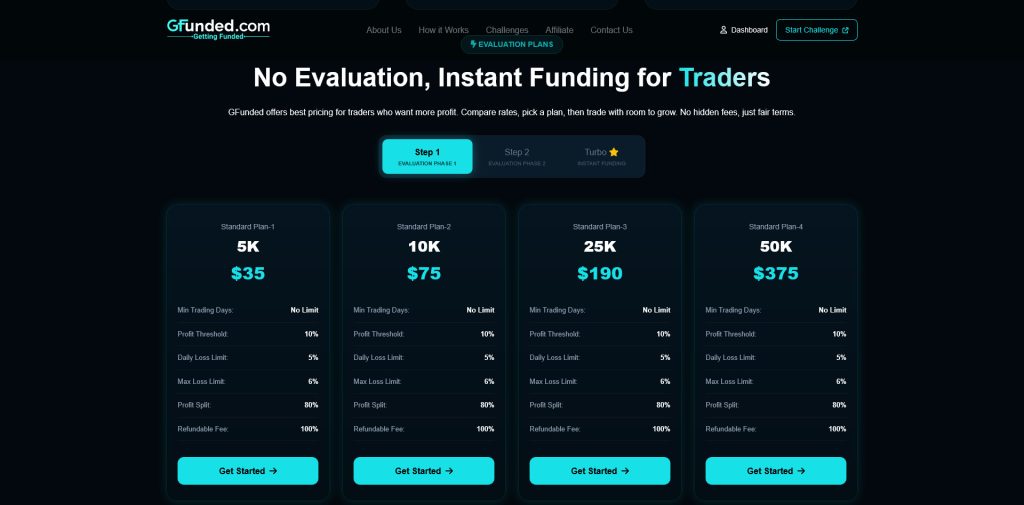
In review roundups and plan summaries, evaluation fees often show up in a rough range of about $95 to $925 for $10,000 to $200,000. Instant Funding is usually higher, with some references pushing up to around $1,499 depending on size and promos. Pricing can shift with discounts, so treat any number as a “typical ballpark,” then confirm your exact checkout total.
A simple budget example, what a mid size evaluation costs and what you must earn
Let’s keep the math clean with a mid-size evaluation that many traders consider a “sweet spot.”
Say you choose a $50,000 evaluation, and the fee lands around a few hundred dollars (reviews often cluster in the high-$200 to mid-$300 range, depending on the plan and promo). You pay that once to access the rules and the platform.
Now translate the common evaluation target into real money:
- 10% GFunded profit target on $50,000 equals $5,000.
So you’re paying a few hundred dollars for the chance to prove you can make about $5,000 under strict limits, then move into the payout stage.
Two reminders matter more than the fee itself:
- The fee is at risk. If you breach a rule (daily loss, max loss, restricted trading behavior), the attempt is usually over.
- “GFunded Refundable” doesn’t mean risk-free. In prop firm language, refundable often means you may get the fee back after you pass and meet the stated conditions. It’s not the same as a normal refund if you fail or change your mind.
If you only remember one thing, price the plan based on what you’ll actually trade, not what looks cheap on a banner.
Add ons that change the deal, weekly payouts, news access, resets, and scaling unlocks
Add-ons matter because they can change both your total cost and the rules you’re trading under. This is where traders get surprised, not because the firm “hid” pricing, but because the base plan and the upgraded plan are not the same product.
Common add-ons mentioned in summaries and trader discussions include:
- Weekly payouts: Many setups are described with a slower default payout cycle (often bi-weekly), then faster withdrawals cost extra. If you upgrade, your “one-time fee” stops feeling small.
- News access (often on evaluations): Some plan types allow news trading freely, others may restrict trading around major releases unless you pay for access. If your strategy trades CPI, NFP, or rate decisions, this can change your whole approach.
- Resets: A reset is a paid second chance after you fail an evaluation. Helpful, but it raises your all-in cost fast if you need more than one attempt.
- Scaling unlocks: Some upgrades are framed as access to higher tiers or features sooner. If you’re not already consistent, paying for “future you” usually backfires.
A practical approach is simple: skip add-ons until you can follow the base rules for a few weeks. Prove you can survive the loss limits first, then decide what upgrades you truly need.
Profit split and scaling, why 50% can still be fine, and when it is a downside
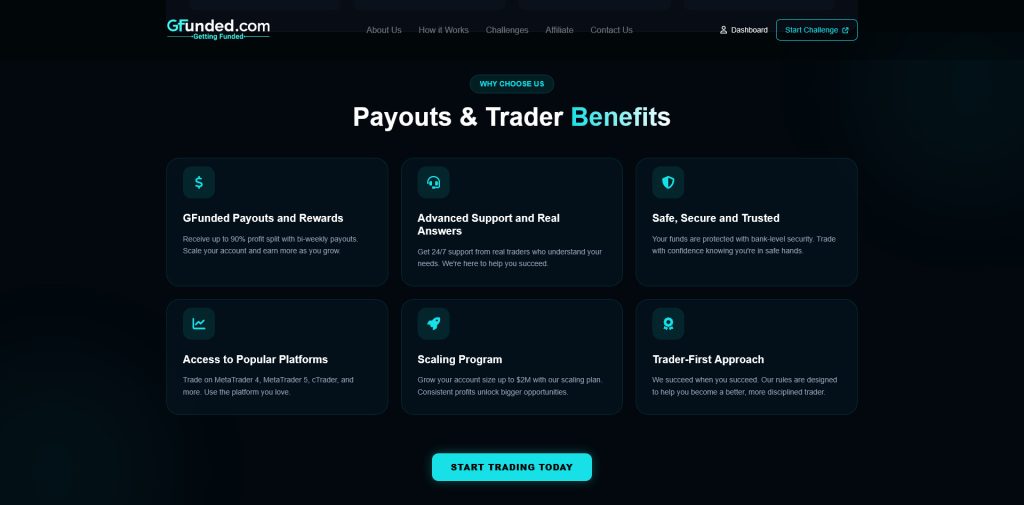
GFunded Profit split is where expectations and reality often collide. Many traders start around a 50% split, then move toward 80% after scaling steps and milestones. That path can be fine, but it depends on how you trade.
A lower split can still work if you:
- Trade a style that benefits from larger account size over time.
- Care more about stability and scaling than squeezing every dollar from each payout.
- Can follow the rules long enough to qualify for better terms.
The 50% split becomes a real downside if you:
- Trade high-frequency, small-edge systems where costs and split eat most of the profit.
- Plan to withdraw often early, where a lower split feels painful.
You’ll also see big scaling headlines, including paths that reference scaling up to $6.4M. Treat that as a ceiling, not a promise. Scaling depends on hitting milestones, staying compliant, and passing payout reviews without rule issues.
Platforms and trading conditions, what it feels like day to day
Day-to-day results at GFunded often come down to two things: the platform you’re placed on and the trading conditions on that setup. That’s why reviews can sound like they’re describing different firms. One trader gets clean fills and predictable costs, another fights spread spikes and clunky order management.
GFunded is most often linked with TradeLocker, DXTrade, and Match Trader, but platform listings can be inconsistent across time, reviews, and even program types. Before you pay, confirm the exact platform you’ll receive for your plan, not the one mentioned in an old review.
TradeLocker vs DXTrade vs Match Trader, how to choose the best fit fast
If your workflow feels “off,” you’ll make mistakes under pressure. A tight daily loss cap doesn’t forgive fat-finger entries or confusion around stops. Pick the platform that supports how you actually trade.
Here’s a quick way to decide:
- TradeLocker: Often a good fit if you want a simple UI and quick execution flow. It tends to suit discretionary traders who care more about clean order entry than advanced customization. If you use hotkeys, partial closes, or quick stop edits, test that specific behavior early.
- DXTrade: Usually feels clean and structured, with solid order management for many traders. The trade ticket and position controls can be intuitive, but it may not match the “muscle memory” of traders who built everything around MetaTrader tools.
- Match Trader: Often chosen by traders who want a modern layout and decent charting without extra complexity. As with the others, what matters is how it handles your core actions: entries, stops, partials, and closing fast during volatility.
GFunded One more reality check: a lot of traders show up expecting MetaTrader. Don’t assume you’ll get MT4 or MT5 tools, templates, or EA support the same way. If your edge depends on MetaTrader indicators or a specific automation setup, platform confirmation comes before everything.
Spreads, commissions, and slippage, why one trader loves it and another hates it
GFunded is typically CFD-based, so costs behave like CFDs. Spreads can widen during high-impact news, around rollover, and in thin liquidity (late sessions, holidays, sudden spikes). Slippage can also show up when price moves fast, especially on stop orders.
This explains the split reviews. Two traders can be “right” at the same time because they trade different:
- Instrument mix: Forex can carry a spread plus commission on some setups, while indices or crypto CFDs may feel cheaper depending on configuration.
- Session timing: London open can feel tight, late US session can feel sloppy.
- Style: Scalpers feel every extra tick, swing traders barely notice.
If you want a clear answer for your strategy, measure your real all-in cost. For your top 3 instruments, log the spread at entry and exit, then add commissions (and swaps if you hold overnight). Do this for a few days and you’ll know if the account fits your edge.
Quick pre trade test, 60 minutes that can save your fee
Before you commit emotionally (and financially), run a quick test like you’re checking a used car before buying it. You don’t need hundreds of trades, you need a clean read on basics.
In about an hour, do this:
- Open the GFunded platform and find your symbols (the exact pairs, indices, or crypto CFDs you trade).
- Check contract specs: contract size, margin, leverage, and trading hours for those symbols.
- Place tiny trades: open and close a small position to see how fills feel, then repeat with a stop and a limit attached.
- Record spreads three times: once during an active session, once near rollover, and once during a quieter period.
- Test stop behavior: move a stop, set a trailing stop if you use it, and confirm how edits work on open trades.
- Save proof: take screenshots of spreads, the trade ticket, and your fills so you can compare later.
That one short test won’t guarantee perfect conditions, but it will quickly show whether the platform and pricing match the way you trade.
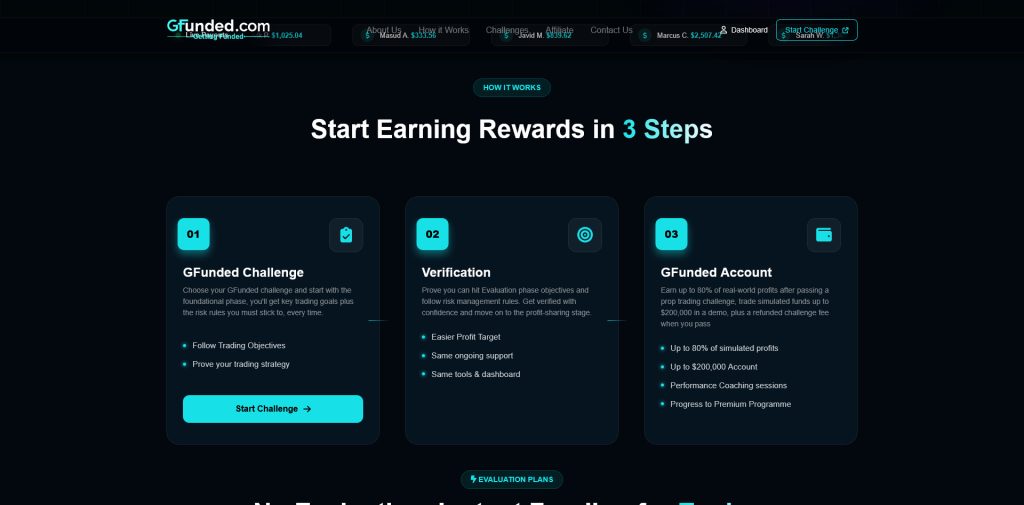
3 simple steps
Payouts and withdrawals, how to get paid without surprises
GFunded Payouts are the moment a prop firm earns trust. With GFunded, the stories tend to split into two buckets: traders who say withdrawals hit in about 2 business days, and traders who say a payout request triggered extra checks or delays. Both can be true because withdrawals are not just a button click. They are a review process, and timing can change by plan and add-ons (many traders describe bi-weekly as the default, with weekly available as an upgrade, and some plans marketed as on-demand once conditions are met).
What happens after you click withdraw, the review steps most firms do
After you request a payout, most firms run the same basic sequence. It’s less about doubting you and more about confirming the account still matches the rules you agreed to.
Here’s the typical flow in plain language:
- Submit the payout request in the dashboard and select a method.
- Compliance review checks the big risk lines, like daily loss, max loss, and whether drawdown was calculated on equity or balance (depending on the plan).
- Restricted tactics scan looks for patterns that can break program terms, like execution abuse, latency-style behavior, or coordinated hedging across accounts.
- Trade behavior review flags unusual shifts, like sudden lot-size spikes, switching styles right before payout, or “hail Mary” trades that look like gambling.
- Internal holding step may happen before release (many traders describe it like a Profit Locker-style stage).
- Payout is sent once everything clears.
That internal holding step is where most frustration comes from. It can feel like an extra hoop, but it’s also where firms slow down to verify the request and keep payouts consistent.
KYC requiredKYC and payment methods, do this early so you do not miss a payout window
KYC delays are one of the most common reasons traders miss a payout window, and it has nothing to do with performance. Handle verification early, even before your first profitable run, so you’re not scrambling later.
Most KYC checks are simple:
- ID verification (passport or driver’s license)
- Address proof (utility bill or bank statement)
- Sometimes payment method verification, depending on how you paid the fee
Payment methods vary by region and program, but in trader reports you’ll often see crypto payouts (USDT is commonly mentioned). Some regions also use third-party payout rails (like Rise). Because methods can be limited, confirm a few details before you request:
- Minimum payout amount
- Processing time (what it says vs what traders see in practice)
- Whether payout speed changes with add-ons or plan type
How withdrawals can affect your drawdown buffer, what to read before requesting
A payout can change your risk cushion, depending on how the plan calculates drawdown after withdrawals. Some setups effectively “rebase” limits after a payout, so your new balance becomes the fresh reference point. If your strategy needs room for normal pullbacks, this detail matters more than the payout speed.
Before you withdraw, re-read two sections like you’re checking a contract:
- Payout rules (timing, conditions, consistency requirements)
- Drawdown rules (trailing vs static, equity vs balance, and what happens after withdrawals)
Also, protect yourself with basic record keeping. Right before and right after the request, save:
- Screenshots of dashboard metrics (drawdown, equity, balance, profit)
- Payout request confirmation
- Exported trade history (weekly is ideal)
If a payout gets reviewed, clean records and steady trading behavior make the process easier, and reduce the odds of “surprise” delays.
Conclusion
GFunded prop firm reviews make more sense once you strip them down to the basics, rules first, then costs, then platforms. This firm can work well for disciplined traders who respect tight daily and max-loss limits, and keep their execution clean. Most complaints still trace back to the same things: drawdown math (trailing vs static, equity vs balance), small rule misses (inactivity, minimum days, news windows), and getting flagged when trading looks like system-gaming.
Before you pay a one-time fee, do a few checks that prevent most headaches. Confirm your country is eligible (the US and Canada are often listed as restricted). Verify the exact drawdown type and how it’s measured. Add up the real all-in price, including any add-ons like faster payouts or news access. Test the platform you’ll actually get (TradeLocker, DXTrade, or Match Trader) for spreads, execution, and basic order handling on your main symbols.
Treat payouts like a planned part of the process. Finish KYC early, request withdrawals inside the rules, and keep records (screenshots, exports, and payout confirmations). Your best edge here is discipline.
Next step: pick the smallest plan that matches your strategy, trade it like a trial run, and only risk the one-time fee you can afford to lose.