Forex No Deposit and Deposit Bonus
Forex No Deposit and Deposit Bonus and offers
let lastScrollPosition = 0;
const footer = document.getElementById('xmStickyFooter');
window.addEventListener('scroll', function() {
const currentScrollPosition = window.pageYOffset || document.documentElement.scrollTop;
// Only show when scrolling down past 100px
if (currentScrollPosition > 100 && currentScrollPosition > lastScrollPosition) {
footer.classList.add('visible');
} else {
}
lastScrollPosition = currentScrollPosition;
}); 




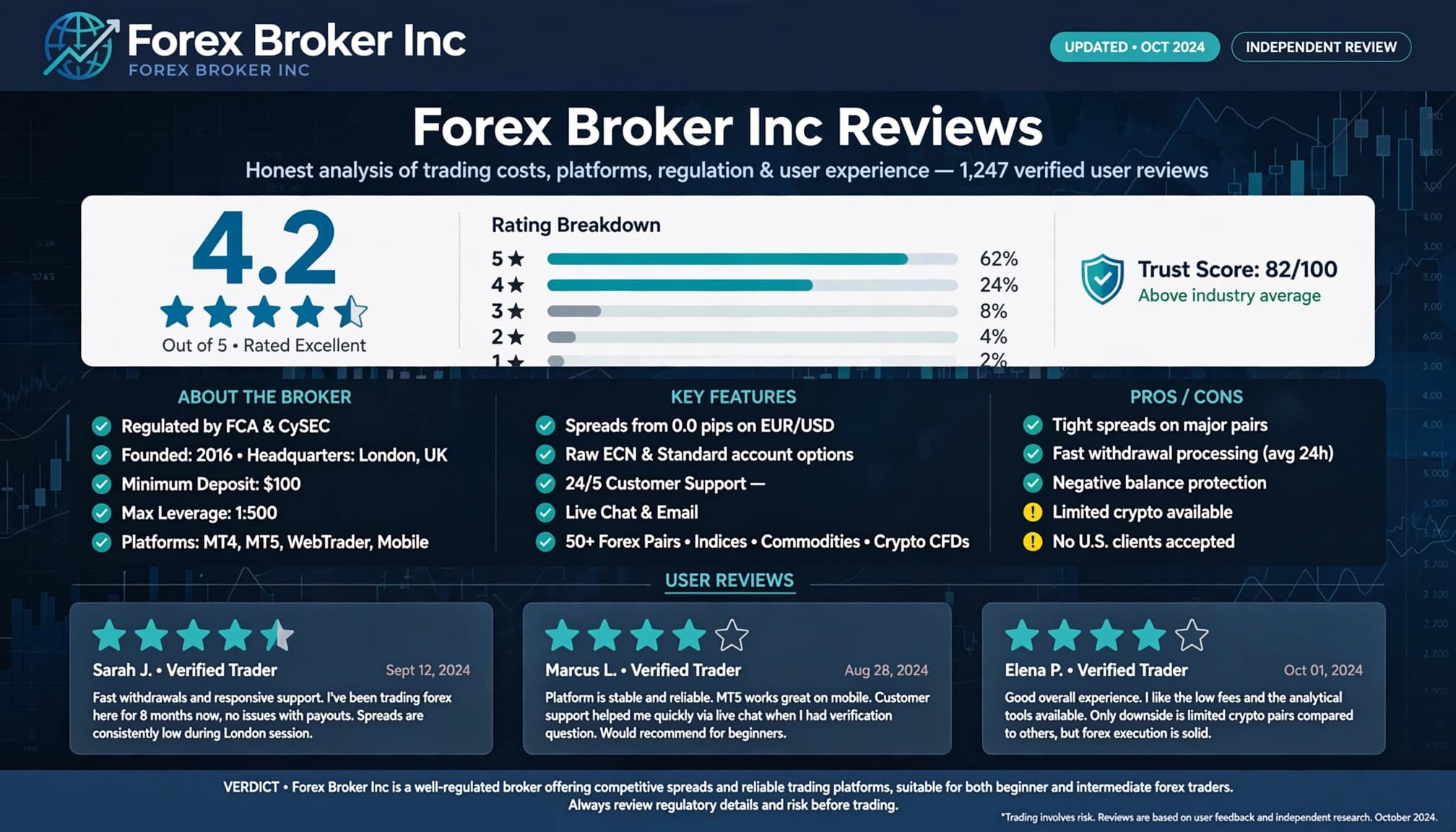






Forex broker reviews often blur the line between regulation and user experience, so the article shows how to judge Forex.com and any other broker. Forex.com is run by Nasdaq-listed StoneX, and its U.S. entity is registered with the CFTC and is an NFA member, which makes it legitimate.
Complaints focus on wide spreads, inactivity fees, slow support, and withdrawal delays from verification rather than lost funds. The piece explains that protection depends on the specific legal entity you sign with, and it lays out a five-step vetting checklist: find the entity, verify it on the regulator’s register, review fees, read recent complaints, and test with a small deposit and withdrawal.
It covers regional regulators, U.S. rules like 50:1 leverage and FIFO, account types, platforms, and hidden costs such as financing and currency conversion. It also teaches readers to spot fake reviews and red flags like guaranteed profits or fees demanded before withdrawal. Forex.com suits U.S. and beginner traders who value oversight over low cost. A four-week low-risk test is recommended, and reviews should be treated as leads, not verdicts.
You search forex broker inc reviews and get a mix of affiliate hype, angry forum threads, and star ratings you can’t verify. That makes it hard to tell whether a broker is safe before you fund an account. Most of the confusion comes from one thing: reviews rarely separate regulation from user experience.
Here is the short answer for Forex.com. It is run by StoneX, a publicly traded group, and its U.S. arm is registered with the CFTC and is a member of the NFA. That is real regulatory oversight, and it puts the broker in the legitimate category. Legit does not mean perfect, though. Users complain mostly about spreads, inactivity fees, and slow support, not about lost funds.
Below, we break down how Forex.com is regulated, what traders report in practice, and which fees to watch. We also show you how to run the same safety checks on any broker, the way we do in our own reviews at ForexItem, before you claim a bonus or deposit a dollar.
Why checking forex broker reviews matters before you deposit
Retail forex carries two separate risks. Market risk is the chance your trade loses money. Counterparty risk is the chance your broker misprices, blocks withdrawals, or simply disappears. Reviews are the cheapest way to measure the second risk before it costs you anything.
Your broker holds your money
When you deposit, you hand funds to a company you will probably never speak to. A U.S.-regulated broker has to keep client money separate from its own and meet minimum capital rules. An unregulated offshore broker has no such duty. The two can look identical on a website, down to the same trading platform and the same smiling stock photos, until you try to withdraw.
Bonuses add another layer. A $30 no-deposit credit sounds free, but the terms may require a minimum trading volume, cap your profits, or void the bonus after one rule slip. Reading reviews and the fine print together shows you whether an offer is worth your time.
What a useful Forex Brokes covers
A good review gives you facts you can check yourself. A bad one gives you adjectives. Look for these items:
The entity point trips up many traders. A broker group can be regulated in one country while the company serving your country is not. Your protection depends on the entity you sign with, not on the brand name on the homepage.
Where reviews mislead you
Star ratings are weak evidence. Happy traders rarely post, while angry ones almost always do, so a 3.5 score can hide a decent broker or a mediocre one. Many review sites also earn commissions when you sign up, and that includes affiliate portals like ours. Ask whether the reviewer discloses affiliate links, and treat any review that never mentions a downside as an ad.
That is why you should treat every review as a lead, not a verdict. Take the claims it makes and confirm them at the source. The NFA’s BASIC database lets you look up a U.S. forex firm and see its registration status and any disciplinary history. If a review says a broker is regulated and you cannot find it on the regulator’s register, you have learned something more important than any star rating.
How to vet a forex brokers like Forex.com step by step
Vetting a broker takes about 20 minutes, and the process is the same for any firm. Run the checks in order, because the first two can end your research early. If a broker fails on regulation, no pile of glowing forex broker inc reviews should change your mind.
The five-step checklist
Start with the paperwork, then move to user evidence, and finish with real money. Each step filters out a different kind of problem.
Running the checklist on Forex.com
For Forex.com, step one has a catch. The brand operates through different legal entities in different countries, so a trader in the U.S. signs with a different company than a trader in the UK or Australia. Confirm which one appears on your agreement, then check its status on the NFA register if you are in the U.S.
Steps three and five matter most after that. Compare the published spreads with what you see on the live platform, and note any inactivity fee. Then do the part most people skip. Withdraw your test deposit and time it from request to arrival.
Keep a simple log of the date, amount, method, and how long each step took. If support takes days to answer a basic question during a $100 test, expect worse when you hold more money with them.
Is Forex.com safe? Regulation, ownership and trust score
Who owns Forex.com
Forex.com is a brand of StoneX Group Inc., a Nasdaq-listed financial services firm that acquired GAIN Capital in 2020. Public ownership means audited financials and regulatory filings that most offshore brokers never publish. That alone is a strong sign the company is not a fly-by-night operation.
Ownership is not protection, though. Your deposit is only as safe as the regulated entity that holds it, and StoneX has renamed and merged several subsidiaries over the years. Confirm the exact company name on your account agreement before you check any register.
Regulation by region
The brand runs under separate licenses depending on where you live. Verify the current entity name on each regulator’s own site, since filings change.
U.S. rules are among the strictest in the industry. Retail forex dealers must hold a minimum of $20 million in net capital, and leverage is capped at 50:1 on major pairs. Forex.com also follows the NFA’s FIFO rule, which stops you from hedging the same pair. Some traders hate that, but it is a regulation point, not a broker flaw.
One caution applies everywhere. SIPC does not cover forex accounts, so a regulated broker lowers your counterparty risk without removing it.
How to read the trust score
Most forex broker inc reviews end with a trust score, and those numbers vary wildly by site. Treat them as a summary, not as proof. Third-party ratings also shift month to month, so check the current figures yourself.
We weigh four factors, in this order:
The verdict so far: Forex.com is safe in the sense that matters most, which is that your money sits with a supervised, well-capitalized firm. Whether it is the cheapest place to trade is a separate question.
Forex.com fees, spreads and account types explained
How Forex.com charges you
Forex.com earns mainly from the spread, the gap between the buy and sell price. On its standard account you pay no separate commission on forex trades, because the cost is built into the quote. Many forex broker inc reviews quote one spread figure without saying which account or hour it came from, so treat those numbers with caution.
Spreads on major pairs like EUR/USD are usually tight in calm markets. They widen around news releases and at the daily rollover. Check live spreads on a demo account during the hours you actually trade, then compare them with two or three other brokers.
Account types at a glance
Available accounts depend on your country, so confirm what your entity offers. U.S. clients have fewer choices than clients in other regions.
The minimum deposit has historically been low, around $100 for many clients. Verify the current figure before you fund anything, since it changes by region and account.
Fees beyond the spread
The costs that surprise traders sit outside the quote. Pull each one from the official fee page and screenshot it with the date:
These are the same fees users complain about most, which we cover next. Add them up for your style. A swing trader should care about financing, while a casual trader who disappears for a year should care about inactivity charges. Compare total cost per month, not the headline spread, and Forex.com’s real price becomes clear.
Platforms, tools and education: what traders get
Trading platforms
Forex.com offers a mix of proprietary and third-party software, and the lineup changes by region. Check which platforms your entity actually supports before you judge the broker on a feature list. Most forex broker inc reviews describe the global menu, not what a U.S. client can open.
Open a demo account and place the same order on web and mobile. Compare the fill price with the quote you saw, and note how fast the platform loads during a news release. Slow execution costs you more than a half-pip of spread.
Research and education
Beyond execution, the broker typically supplies market commentary, an economic calendar, and technical analysis tools. These help you plan around events like U.S. jobs data or central bank decisions. Quality varies by region, so browse the research pages while logged into a demo, not just on the public site.
Education usually includes beginner guides, platform tutorials, and recorded or live webinars. Treat this as a bonus, not a reason to pick a broker. Good lessons explain position sizing and risk management, not just chart patterns. If the material mostly pushes you toward bigger trades, skip it.
Finally, match the tools to your level. Beginners need a clean interface, a demo, and clear tutorials. Active traders should care more about charting depth, automation support, and stable execution. Write down the three features you will actually use, then confirm each one works before you deposit a dollar.
What real users say: common praise and complaints
The pattern across forex broker inc reviews on Trustpilot, Reddit, and app stores tells you more than any single score. We did not run a survey, so treat this as a summary of recurring themes, not statistics. Check the latest posts yourself, because experiences change after platform updates and staffing shifts.
What traders praise
Positive feedback centers on trust and tooling. Traders often say they chose Forex.com because it is a known, regulated name, which matters most to U.S. clients who have fewer safe options. Users also like the range of platforms and research compared with smaller brokers.
What traders complain about
Complaints are just as consistent. Most are about cost and service, not missing money. Here is how each theme breaks down and what you can do about it.
How to weigh the feedback
Sort every complaint into one of two buckets. A grievance about fees or rules is a pricing problem you can measure and avoid. A grievance about blocked or refused withdrawals is a safety problem, and one credible, documented case outweighs ten complaints about spreads.
Finally, check dates and details. Recent, specific posts that name an account type and a timeline are worth reading. Vague rants with no dates are noise. If you spot a repeated story in the last 12 months, test it with your own small withdrawal before you trust the broker with more.
How to spot fake reviews and forex broker red flags
Signs a review is fake or paid
Fake feedback follows patterns. When you read forex broker inc reviews, watch for bursts of five-star posts within a few days, and for reviewers who have only ever written one post. Real users usually mention a detail, such as an account type, a withdrawal date, or a specific platform problem.
Paid reviews are harder to catch. Affiliate sites earn when you click, and that includes ours. Disclosure is the test. An honest page states the relationship and still lists real downsides.
Broker red flags that matter most
Some warning signs show up before you ever deposit. Check the list below against any broker, Forex.com included.
The last item deserves extra weight. No real broker asks you to pay more money to release your own money. Taxes and fees are deducted from your balance, not charged as a new deposit.
What to do when something feels off
Stop funding the account first. Then search the exact company name with words like “warning” or “complaint,” and compare it against the regulator’s register, such as NFA BASIC for U.S. firms. If the entity is missing, treat that as your answer.
If you have already lost money, report it to the CFTC and keep every screenshot, receipt, and chat log. Be careful with anyone who contacts you offering to “recover” lost funds for an upfront fee. Recovery scams target people who have already been burned, and they follow the same script.
Who Forex.com suits and how to test it with low risk
Who it fits and who it doesn’t
Forex.com fits U.S. traders who value regulation and polished platforms over the lowest possible cost. It also suits beginner forex traders, because the demo account and education library let you learn before you risk a dollar. Active traders who want deep charting and a supervised, well-capitalized counterparty will find it a reasonable home.
Look elsewhere if you chase high leverage, hedging, or frequent promotions. U.S. rules cap leverage at 50:1 and enforce FIFO, so those limits come with the territory, and U.S. clients should expect fewer bonus offers than traders in other regions. If you trade from outside the U.S., check which entity and rules apply to you, since terms differ by country.
A four-week low-risk test
Treat your first month as an audit, not an investment. The point is to confirm what the forex broker inc reviews told you, using money you can afford to lose entirely. Keep the total small, for example $100 to $250, and log every step.
Score each step pass or fail. If the withdrawal is smooth and your costs match your estimate, raise your deposit gradually and keep watching the fee schedule. If any step fails, close the account and withdraw what remains before you decide whether the problem is the broker or your own setup.
Final verdict on Forex.com’s legitimacy
Forex.com is legit. A publicly traded group owns it, and its U.S. entity is registered with the CFTC and the NFA. The real downsides are about cost and service: spreads, inactivity fees, and slow support, not missing deposits. That makes it a solid fit for U.S. traders who value oversight over rock-bottom pricing.
The bigger lesson applies to every broker. Treat forex broker inc reviews as leads, not verdicts. Confirm the legal entity, check the regulator’s register, read the fee page, and test a small withdrawal before you scale up. A broker earns your trust by paying you back, not by its star rating.
Want to compare more brokers the same way? Browse our safe, regulated forex broker reviews and current bonus offers at ForexItem, where we apply these same safety checks before you claim a no-deposit or deposit bonus.