Forex No Deposit and Deposit Bonus
Forex No Deposit and Deposit Bonus and offers
let lastScrollPosition = 0;
const footer = document.getElementById('xmStickyFooter');
window.addEventListener('scroll', function() {
const currentScrollPosition = window.pageYOffset || document.documentElement.scrollTop;
// Only show when scrolling down past 100px
if (currentScrollPosition > 100 && currentScrollPosition > lastScrollPosition) {
footer.classList.add('visible');
} else {
}
lastScrollPosition = currentScrollPosition;
}); 




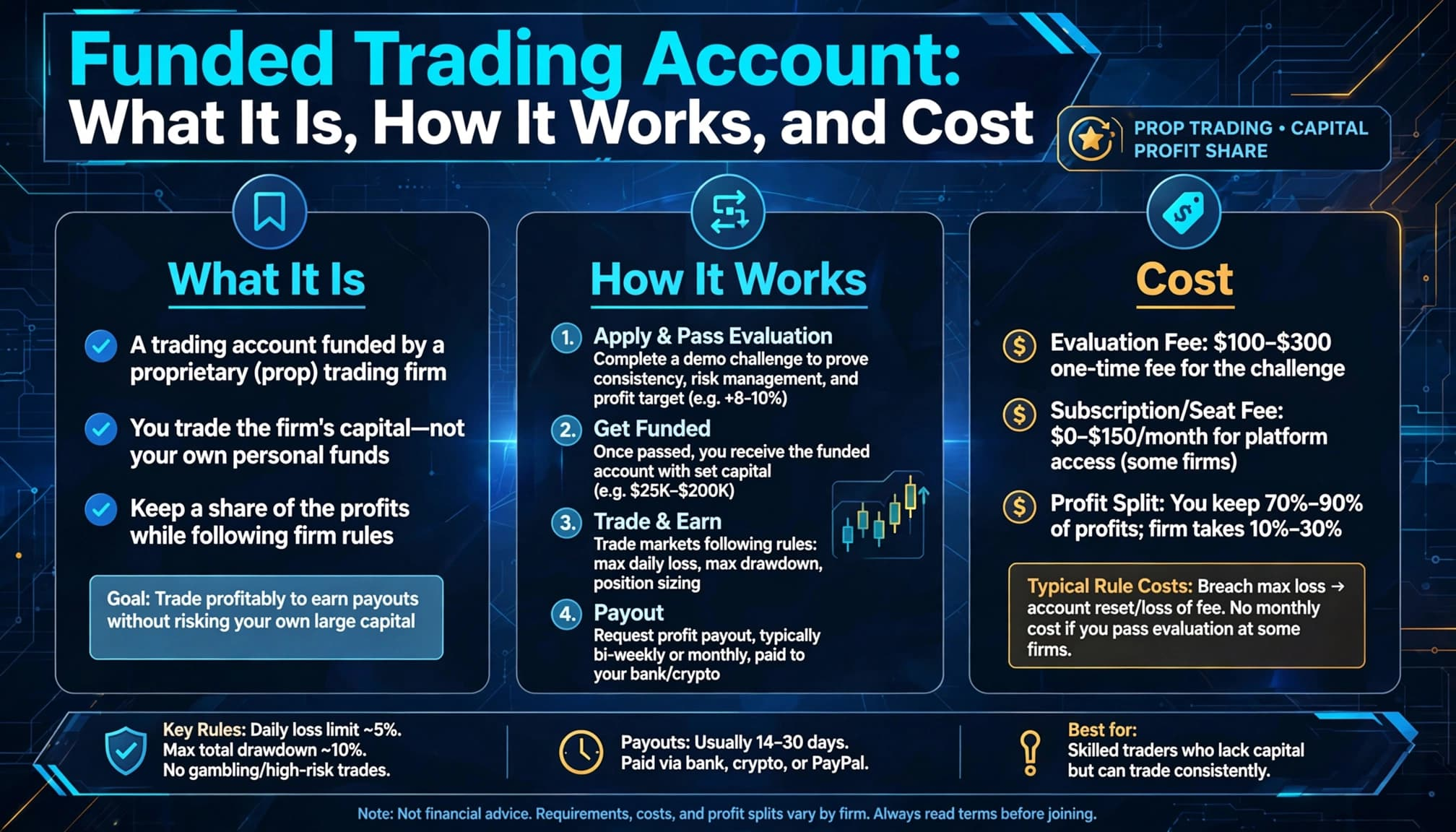








A funded trading account gives traders access to a prop firm’s capital after they pass a paid evaluation with a profit target and strict loss limits, letting them keep roughly 70% to 90% of profits while risking only the challenge fee.
Fees run from about $50 to $600 depending on account size, and many firms refund them after the first payout, though traders should budget for two attempts plus extras like resets, subscriptions and withdrawal costs. Passing depends on understanding how drawdown is measured (static, balance trailing or equity trailing) and on obeying conduct rules covering news trading, consistency, holding limits and automation.
A repeatable plan means risking small, setting a personal daily stop, and keeping the same risk size after funding. Forex offers the widest choice of firms, while stocks and options are more limited and futures usually charge monthly subscriptions with trailing drawdown. Traders should vet firms through independent reviews and verifiable payout history, avoid red flags such as guaranteed profits or shifting rules, test with the smallest account, and keep screenshots of the rules. The approach suits traders with a tested strategy and discipline.
You want to trade with real buying power, but you do not want to put thousands of dollars of your own savings on the line. That is the problem a funded trading account solves. A prop firm gives you access to its capital, you trade it under set rules, and you keep a share of the profit. It sounds simple, yet the fine print on fees, drawdown limits, and payouts trips up a lot of new traders.
Here is the short answer. A funded account is firm capital you earn access to by passing an evaluation, usually a paid challenge with a profit target and strict loss limits. Most challenges cost roughly $50 to $600 depending on account size, and many firms refund the fee after your first payout. You typically keep 70% to 90% of the profits.
Below, we explain how funded forex trading accounts work step by step, break down what they really cost, and show how to pass an evaluation. We also cover what to check before you pay a firm, such as payout history and rule clarity, so you can compare options with confidence.
Why a funded trading account matters to traders
Most retail traders hit the same wall. They have a workable strategy and a small balance, so the profits stay small too. Trading with a funded account changes the math, because your results are measured against firm capital instead of your savings. Here is why that matters in practice.
It removes the capital barrier
Take a $1,000 personal account risking 1% per trade. You risk $10 a trade, and a good 5% month earns you $50. Run the same strategy on a $100,000 account and the percentages stay identical, but the dollar results are 100 times larger. For a trader in South Africa, that is a balance worth well over a million rand, which few people can fund themselves.
Notice the last row. With funded account trading, the fee is the only money you commit. The table assumes you pass and keep the same win rate, and that is the hard part. Later sections cover how to do it.
It caps your downside
Your maximum loss is the challenge fee. If you breach a drawdown limit, the firm absorbs the trading loss and you walk away. Compare that with a live account, where a 20% drawdown on $5,000 costs you $1,000 of your own money. That is why trading funds from a prop firm appeals to cost-conscious traders who want to prove a strategy without risking their savings.
Be realistic about the odds, though. Most challenge attempts fail, so budget for a second attempt before you start. Treat the fee as the price of a tested strategy, not as a guaranteed route to income.
It builds discipline you can measure
Every evaluation hard-codes risk rules that many traders never apply on their own. Typical limits look like this:
Those limits work like a strict coach. They stop you from revenge trading after a loss or doubling your size to hit a target. If your strategy only works with oversized positions, the evaluation exposes that quickly and cheaply.
Finally, know what you are buying. Many firms run evaluations, and sometimes the funded stage too, on simulated accounts, with payouts coming from the firm’s revenue. You still get paid real money when you follow the rules. But you are signing a performance contract, not opening a brokerage account, so read the terms before you pay.
How to get a funded trading account
Learning how to get a funded trading account comes down to a fixed sequence. Firms differ on details, but the route is nearly identical everywhere: you pay for a challenge, hit a target inside the rules, and earn access to firm capital.
The steps from sign-up to funded
Work through these in order. Skipping the first step is where most traders lose their first fee.
The order matters more than the speed. Traders who rush into step 3 with only a vague read of the rules often fail on a technicality, such as holding a trade through restricted news.
What happens after you pass
Passing the challenge does not mean money lands in your bank. Firms review your trading history for banned practices like latency arbitrage or copying signals from other accounts. Once you clear that review, you receive a funded forex trading account (or the equivalent for stocks or futures) with no profit target. Your first payout usually opens after 14 to 30 days, and many firms refund your challenge fee with it.
That line is the one most traders ignore. After passing, they raise their position size to “make it count” and breach the drawdown within a week. Keep the lot size, session, and setups that got you through the evaluation. Withdraw early, even a small amount, so you have proof the process works and the fee is already covered.
How much a funded trading account costs
So, how much is a funded trading account? You never buy the account itself. You pay for the evaluation, and the fee scales with account size. Expect roughly $50 for a small account and $600 or more for $100,000. Price alone is a poor guide, because the rules decide your odds of passing.
Typical challenge fees by account size
The table shows common one-time fees for forex evaluations. Exact prices vary by firm and change with promotions, so check the current pricing page before you pay.
Fees land at roughly 0.5% to 1% of account size, so larger accounts cost less per dollar of buying power. A bigger account also means a bigger fee to lose if you fail, which is why starting small is the safer move.
Costs beyond the challenge fee
The sticker price is only part of the bill. Before you buy funded trading accounts from any firm, look for these extras:
None of these is a red flag on its own. Hidden or vague fees are, so make sure the firm lists every charge before checkout.
Working out your real cost
Now add up the whole path instead of a single fee. Say you buy a $25,000 challenge at $200 and fail once. You pay again and pass on the second attempt. That is $400 spent. Your first payout refunds one fee, so the net cost is about $200 before you earn any profit.
Plan for two attempts in your budget, and only spend money you can afford to lose. If a firm’s refund depends on conditions you cannot meet, such as a minimum number of payouts, count the fee as gone. Treat any refund as a bonus, not as part of the plan.
Evaluation rules and how to pass them
Most failed challenges do not fail because of a bad strategy. They fail because the trader misread a rule. Before you pay for a funded trading account evaluation, learn how each limit is measured, not just how large it is.
How drawdown is measured
The drawdown type decides your real room for error. Take a $10,000 account with a 10% maximum loss limit, after you grow it to $10,500:
Equity-based limits count floating losses too, so a trade that dips hard before it recovers can still end your challenge. Prefer static or balance-based drawdown when you have the choice, and confirm which one applies in the rulebook.
Conduct rules that catch careful traders
Beyond drawdown, read the conduct rules line by line. These are the ones that quietly void trading funded accounts for people who hit the target:
If a rule is unclear, ask support and keep the written reply. A firm that answers vaguely before you pay will answer worse after you win.
A pass plan you can repeat
Start with the arithmetic. A 10% target on $10,000 is $1,000. Risking 0.5% ($50) per trade at a 1:2 reward earns $100 per winner, so you need roughly ten net winning trades. Most evaluations give you 30 days or more, and many now have no time limit at all, so there is no reason to force trades.
Then add your own guardrails. Set a personal daily stop at half the firm’s limit, for example 2% when the firm allows 4%. Trade only the setups you have already tested on a demo or your own account, and stop for the day after two losses. If you pass with this routine, you have a process you can carry straight into the funded stage.
Funded accounts for forex, stocks, options, and futures
The idea is the same in every market, but the product is not. A funded trading account for forex follows different rules than one for futures, and those differences change your cost and your odds. Start with the market where you already have a tested edge, because learning a new instrument while paying for a challenge is expensive.
Forex and stocks
Forex has the widest choice. Dozens of firms sell a forex trading funded account, so comparing fees, splits, and rules is easy. Leverage usually runs from 1:30 to 1:100, and most accounts are simulated. Be careful with the phrase fully funded forex trading account. It normally means you face no profit target after passing, not that real money backs each trade.
Stocks come with more limits. A funded stock trading account, sometimes called a funded equity trading account, is offered by far fewer firms. Expect caps on share size, intraday-only holding, and rules tied to day-trading regulations. Check how the firm treats earnings gaps before you hold anything through a report.
Options and futures
Options are the rarest. Only a handful of firms offer a funded options trading account, and many ban undefined-risk positions or holding through expiration. Get written confirmation that your strategy is allowed before you pay.
Futures prop firms are the main alternative to forex. Firms there typically charge a monthly subscription until you pass, and most use a trailing drawdown that follows your peak balance. Contract limits also scale with account size, so a $50,000 account caps how many contracts you can hold at once.
How the four compare
Use this table as a starting filter, then check each firm’s own rulebook before you commit.
How to choose a prop firm and avoid red flags
Choosing the firm matters as much as passing the challenge. A cheap funded trading account from a firm that stalls on withdrawals costs you more than a pricier one that pays on time. Judge every firm on verifiable payout history and rule clarity, not on discount banners.
What to check before you pay
Start with the evidence. Look for independent trader reviews and payout proof that the firm did not write itself, and note how long it has operated. Then read the rulebook to confirm the drawdown type and refund terms. Use this checklist:
Red flags that should stop you
Some warning signs show up quickly. A firm offering a fully funded trading account with no evaluation and no fee is usually selling something else, such as a course or a signal subscription. Real firms take on risk, so they screen traders first, and free capital with no conditions is not a business model.
Walk away if you see any of these:
Test the firm with a small account first
Finally, test the firm cheaply. Buy the smallest account size, pass it, and request your first payout. If the money arrives on schedule, you can scale up with confidence. If it does not, you lost $50, not $500.
Also screenshot the rules page on the day you buy, because terms can change. Save every support email as well. If a dispute comes up, written proof of the original rules is your only leverage, and a firm with nothing to hide will not mind that you keep it.
Is a funded account right for you?
A funded trading account fits you if you already have a tested strategy, can follow strict loss limits, and can afford to lose one or two challenge fees. It does not fit you if you need guaranteed income or tend to oversize trades after a loss. Be honest about which trader you are before you pay.
Start small and keep the process simple. Pick a firm with verifiable payout history, buy the smallest account, risk little per trade, and request your first payout before you scale. Save the rulebook and your support emails as proof.
If you would rather test a broker with bonus money before paying for a challenge, you can compare no deposit forex bonus offers and read broker reviews at ForexItem’s forex bonus hub. Then choose the route that costs you the least to learn.