
Amillex Forex Broker Review and Ratings
Picking a broker often comes down to one thing: trust. Low spreads look nice, but they matter less if the company behind them feels hard to verify.
Amillex is getting more attention in 2026 because it mixes retail trading access with a background in trading technology. It started in 2014 as a fintech and infrastructure provider, then moved into the retail broker space. That history makes it worth a closer look, especially if you care about regulation, platforms, pricing, funding, and day-to-day reliability.

What Amillex Is and Who It May Suit
Amillex is a global forex and CFD broker. It gives clients access to currency pairs, metals, energy products, stock indices, crypto CFDs, and share CFDs through the MetaTrader platform family.
That setup will appeal to a certain kind of trader. If you want MT4 or MT5, a low entry point, and access to several markets from one login, Amillex checks those boxes. Newer traders may like the simple account lineup and the option to start small. More active traders may look at the tighter spread account and the broker’s focus on execution speed.
It also fits traders who don’t want to learn a custom platform. Amillex sticks to familiar third-party software, which lowers the learning curve for anyone who’s used MetaTrader before. Copy trading is also part of the offer, which may interest users who prefer a more hands-off approach.
At the same time, Amillex won’t suit everyone. Traders who want cTrader, a broker-built platform, or a long public track record as a retail brand may feel better elsewhere. The company has roots in trading tech, but its consumer-facing brokerage arm is still building name recognition.
From fintech provider to retail broker
Amillex says its story began in 2014, when the business focused on trading technology and infrastructure for institutional clients. Later, it expanded into retail brokerage services.
That background matters because a tech-first company often puts more attention on execution, platform stability, and account systems. It also helps explain why Amillex leans on well-known software instead of trying to push a flashy in-house terminal.
Retail traders don’t always care how a broker started. Still, a firm that spent years around trading infrastructure may have a stronger operational base than a brand that appeared overnight.
Markets and tools available in one account
Amillex gives traders broad market access. The lineup includes forex majors, minors, and some exotics, plus gold, silver, crude oil, natural gas, indices, crypto CFDs, and stock CFDs. Some materials also mention soft commodities and bond CFDs.
That range is useful because you can shift between markets without opening separate accounts. If the forex market is flat, you can look at gold, oil, or equity indices on the same platform.
Because these are CFDs, you don’t own the underlying asset. You trade price movement instead, which works for both rising and falling markets. For many traders, that convenience is one of Amillex’s stronger selling points.
Is Amillex Regulated and Safe to Use?
This is the part most traders should read twice. Amillex operates through more than one entity, and the level of oversight depends on which one holds your account.
In Australia, Amillex Markets Pty Ltd is regulated by the Australian Securities and Investments Commission, under AFSL 559321. The group also includes Amillex Global Ltd in Mauritius, licensed by the Financial Services Commission as an Investment Dealer, with license number GB24203163. Another entity, Amillex Global LLC, is incorporated in Saint Vincent and the Grenadines under company number 4421 LLC 2026.
That structure is common among brokers with an international client base. It gives the company room to serve traders in different regions. However, it also means protection levels, available products, and trading conditions may differ depending on where you’re onboarded.
Always check which Amillex entity will open your account, because rules and protections can change by region.
Why ASIC matters for trader protection
Among the names tied to Amillex, ASIC is the strongest trust signal. Australia’s regulator is known for strict licensing standards, compliance checks, and reporting requirements.
For traders, that doesn’t mean zero risk. It does mean the broker’s Australian entity operates under a tougher framework than many offshore-only firms. That can support better transparency and stronger internal controls.
If you’re comparing brokers, an ASIC-regulated entity usually carries more weight than a loosely supervised offshore registration. Still, the benefit is most direct when your account sits under that Australian arm, not a different group company.
Extra safeguards beyond regulation
Amillex also promotes several client protection features. Client funds are held in segregated accounts, which means customer money is kept apart from the broker’s operating funds. The broker also says it offers negative balance protection, so clients shouldn’t lose more than the money in their account.
Another point worth noting is professional indemnity insurance of up to USD 1.5 million through Eagle Insurance. That adds an extra layer around the firm’s operations, though it is not the same as personal deposit insurance for each trader.
These protections help, but they don’t erase trading risk. A regulated broker can still be a poor fit if pricing is unclear, and a well-protected account can still lose money fast in volatile markets.
Trading Platforms, Pricing, and Account Choices at Amillex
Amillex keeps the trading side fairly simple. You get MT4 or MT5, three main account types, spread-based or commission-based pricing, and access to high leverage. That mix covers most common retail trading styles.
The weak point is platform choice. If you prefer cTrader or a broker’s own app with custom tools, Amillex won’t give you that. For MetaTrader users, though, the offer is easy to understand.
MT4 and MT5 for desktop, web, and mobile
Offering both MT4 and MT5 is a practical move. MT4 remains popular with forex traders because it’s light, familiar, and widely supported by Expert Advisors. MT5 adds more order tools, more charting depth, and broader market support.
Both platforms are available on desktop, web, iOS, and Android. That gives traders the usual set of features, including one-click trading, custom indicators, alerts, automated strategies, and backtesting.
If you run trading bots, MetaTrader also has an edge because of its large community and established script ecosystem. On the other hand, traders who want a modern alternative interface may feel limited here.
RAW, Classic, and Standard accounts explained simply
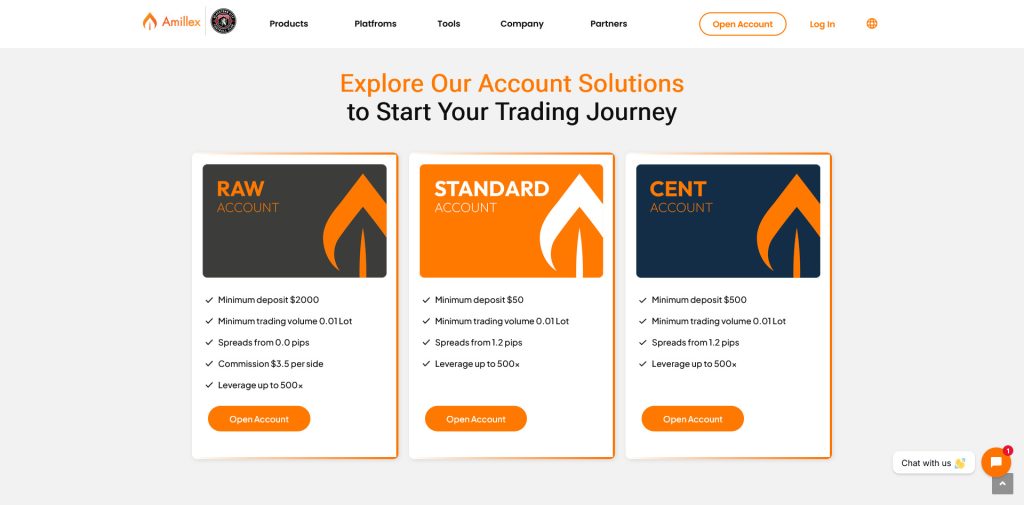
Amillex‘s account structure is built around pricing style, not complicated feature gates. The broker’s written account descriptions list a $50 minimum deposit for all three live accounts, although some promotional graphics have shown higher figures for certain accounts. That inconsistency is worth checking before you fund.
Here is the simple comparison:
| Account | Minimum deposit | Spread style | Commission | Best fit |
|---|---|---|---|---|
| RAW | $50 listed in written materials | From 0.0 pips | $3.5 per side | Active traders, scalpers, algo users |
| Classic | $50 | From 0.8 pips | None | Traders who want lower spreads without commission |
| Standard | $50 | From 1.2 pips | None | Beginners and casual traders |
All three account types list 0.01 lots as the minimum trade size. The main choice is simple: pay commission for tighter pricing, or skip commission and accept wider spreads.
Leverage, spreads, and what traders should watch
Amillex offers leverage up to 1:500. That gives traders more market exposure from a smaller deposit, but it also raises risk fast. A small move can help you, or hurt you, much more than expected.
The broker advertises spreads from 0.0 pips on the RAW account. Meanwhile, published average examples on spread-based pricing have included about 1.5 pips for EUR/USD, 1.8 for GBP/USD, and 2.5 for USD/JPY. Those figures can change with market conditions, so they should be treated as a guide, not a promise.
Most traders should also ask about execution details before opening an account. Amillex highlights quick order handling, but its public materials don’t say enough about execution model specifics for every account type.
Deposits, Withdrawals, and Trading Costs That Matter Day to Day
Funding options can make or break the user experience, especially if you’re outside the usual card-and-bank-transfer markets. Amillex does well here, at least on variety.
The broker supports crypto, local payment rails, e-wallets, and bank transfer. Many of those methods appear geared toward Asian and international clients, which gives Amillex broader reach than some brokers that stick to only a few payment channels.
Payment methods and funding speed
Available methods include USDT on ERC-20 and TRC-20, bank transfer, ChipPay, Help2Pay, FPX, DragonPay, THB QR payment, UnionPay, FasaPay, and other e-wallet options. For many of these channels, the published minimum starts at $50. UnionPay starts higher, at $100, while bank transfer may allow much larger amounts.
Speed is another plus. Many local methods and crypto deposits are listed as instant. That matters if you need to fund quickly during active market hours.
Crypto is especially useful for traders who move funds across borders often. Local QR and regional payment services also lower friction for users who don’t want to rely on cards or international wires.
What to know about fees, limits, and payout times
Amillex promotes low or zero deposit fees, which is a good start. Still, that doesn’t answer every cost question. Payment providers may add their own charges, and currency conversion can still apply depending on how you fund.
Limits vary by method. Some options top out at $10,000, $15,000, $20,000, or $50,000 per transaction, while bank transfer may have no stated upper limit. On the payout side, many electronic methods are listed at up to 24 hours, while bank transfers can take up to five business days.
The main gap is withdrawal clarity. Traders usually want a clean page that spells out cut-off times, internal fees, and whether extra verification can slow a payout. Amillex provides a broad menu of methods, but more detail would improve confidence.
Final Verdict on the Amillex Forex Broker Review
Amillex looks more credible than a broker built on marketing alone. The strongest reasons are its ASIC-regulated Australian entity, its longer history as a trading technology business, and the added protections it says it offers, such as segregated funds, negative balance protection, and professional indemnity insurance.
The trading package also makes sense. MT4 and MT5 are still the default choice for many retail traders, and the account options are easy to understand. Broad market access and flexible funding methods add to the appeal.
Still, there are limits. Platform choice is narrow, public details on some trading conditions are thin, and the multi-entity setup means you need to confirm which rules apply to your account. The mixed messages around minimum deposits on some account materials don’t help either.
For traders who want a low starting cost, MetaTrader access, and a broker with infrastructure roots, Amillex is worth a serious look. For traders who want one top-tier regulator across all clients, deeper public fee detail, or more platform variety, it may fall short.
Conclusion
Amillex will suit traders who value familiar platforms, broad CFD access, and flexible funding. It may not suit people who want the clearest possible fee schedule or a wider platform menu.
The main decision comes back to trust, the same issue that matters more than headline spreads. Check which entity will hold your account, compare the real trading costs, and keep position size under control if you use high leverage. If those pieces line up with your needs, Amillex looks like a broker with substance behind the branding.
More Forex Broker Reviews
 Read this FP Markets Forex Broker Review for a clear look May 23, 2026
  Elev8 Reviews About This Forex Broker Before You Deposit May 7, 2026
  CTForex Forex Broker Review and Scam Risk Assessment April 12, 2026
  Valetax Forex Broker Review to compare the broker pros and cons April 12, 2026
  Doto Forex Broker review and ratings that cover fees December 14, 2025
  FXON Broker Review Hidden Fees & Trading Costs Exposed May 15, 2025


